So, I’m a serial halfwayer. Walk through my house and you will stumble over at least five books I’m halfway through, countless games I’ve gotten half to three-quarters into, a stack of semi-read comics, a few paintings that are “almost” done, piles of novels and short stories in various forms of “progress,” and rooms that are half-clean. It’s a chronic problem I fear I was born with (and I could certainly make the case that it is genetic—or at the very least, “learned behavior”). When I was younger it was not so much of a problem. I could start a book, read all the way to the middle point, and then put it down. A year or so would pass before I would pick the book up, find where I was, and keep going without missing a beat (or needing to really wonder where I was in the narrative). Age has taken that ability from me, but it hasn’t taken the problem of half-way doing something. Point and case:
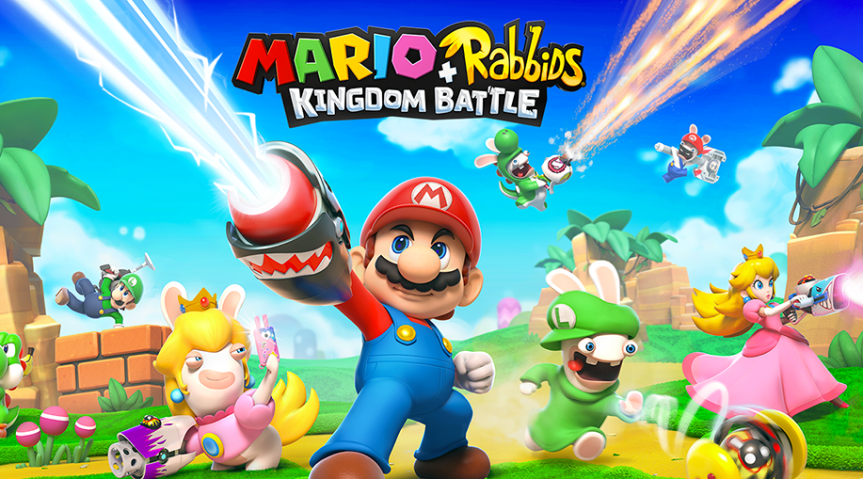
Mario + Rabbids: Kingdom Battle had its hooks in by the end of the second or third map. I was sold on its tactical combat, incremental upgrade system, skill trees, and weapons shop. But, and here is the “it’s not you, it’s me” moment, I got about halfway through the game in the first two weeks after it launched and then put it down. Here we are six months later, and I’m finally getting around to finishing it. It’s a chronic problem, but going back to this game has been worth every moment.
Let me come right out and say it—I like this game. Mario + Rabbids: Kingdom Battle is a strategy RPG in the style of XCOM (my earliest reference point), in which you command three heroes (Mario must always be in your party, the other two slots must contain at least one Rabbid and a third unit of your choice) onto a grid based map. Mixing and matching fighters was one of my favorite things about the game, and starting each battle eagerly scanning the battlefield, checking unit types and move distance, always made me feel like I had a secret edge. But mixing units means more than just mixing special abilities and a coat of paint, it means finding weapon combinations as well.
For example, a map may contain multiple heavy striking units. I know if I place a unit whose weapon or ability is “Vamp,” a shortened version of “Vampire” (meaning the unit takes life from the enemy to restore his/her own), in the front and attack first, any other succeeding unit will gain back health from striking the infected enemy. This freed me from having to always take a healer into battle. No healer generally means “more damage,” and there are maps where that tactic is essential. Or, perhaps the objective is to get to a certain location. Taking the time at the beginning of each map to plan allowed me to measure out movement, make sure I had the units with the largest move radius, and ensure that I knew the best angle to attack. I frequently found myself getting a few moves into a map, changing my mind, and then quitting out to rethink my attack plan (especially during escort missions). But all of this I did with a sense of joy and excitement.
I never found the maps repetitive in a way that felt cursory or lazy. And there is generally enough variety in cover, elevation, and attack routes that I never felt boxed in by a single solution. That is not to say there are not some tight, tough moments. There are. Fighting a boss five times the size of your entire squad is often a tough one-solution call, especially when he can charge across the entire map, smash you with a hammer for half your life, and then finish you off on his next turn. Don’t think that the cute graphics and Rbbid-appeal mean this game is not challenging, at times it is. Some of the latter maps made me scratch my head in frustration, or forced me to go diving back into older levels to gain some much needed upgrade money. At first this felt like a chore, but Mario + Rabbids allows you to replay any mission for that “Perfect” score, and I quickly became obsessed. There are ten challenge missions of various difficulties per world and even a co-op mode to keep you stocked in coins and skill orbs, which you are going to need to tackle some of the final missions. But don’t be discouraged, the game never really felt punishing. I mean, I died—often in glorious fashion—but this usually happened when I just charged into a map head first. Even then, however, the game is forgiving enough that I found these exercises to be learning affairs. And there is something to be said for knowing that a few more coins will net you a better weapon you can bring into that tough fight—and with the odds a little more even, that tough fight becomes an exercise in strength and precision.
There is a story here, and I think it’s worth sitting through at least once. Despite the Rabbids, there are some genuinely funny moments. In a way, the Rabbids offer the perfect satire of the Mushroom Kingdom. Rabbid Mario takes the tropes his legit counter part has been flouting for years and stretches them to comical proportions. Rabbid Peach’s obsession with selfies I found to be a witty satirization of Peach’s penchant for propriety. There’s some great stuff here, and I never felt that the invaders were in any way ruining the Mario we’ve come to know over thirty years. It all feels like an act of love, and this is seen in almost every aspect of the game.
The art style is beautiful and rich. The music is fantastic, and more than once I found myself humming the battle tunes (I’m a sucker for an oboe). There are warp cannons, challenges, and secrets. The game constantly gives you access to a task, even after you complete the main story. It is, however, by no means a perfect game.
I found the environmental puzzles too easy, but I never passed up on completing one. I liked that there were chests strewn throughout the world, but I wish they would have contained things other than collectables. Sure, you get the occasional weapon or skill orb, but I would much rather go around collecting weapon’s parts and get to customize my team before battle. Also, I like the idea of the hub world, but I did not like the application of it. I found running around Peach’s castle annoying for the most part. After you thoroughly explore it, the castle becomes more of a chore to circumnavigate than anything. I also need to note that I found viewing the game in handheld-mode to be blurry, like the screen had Vaseline smeared on it (it is beautiful in docked-mode, however).
Despite any minor gripes, Mario + Rabbis is a fantastic game, and I will buy the sequel day one. It may have taken me several months to complete, but that’s more about my problem than it is the game itself. Seriously, buy and play this game.
 A. D. Bowen