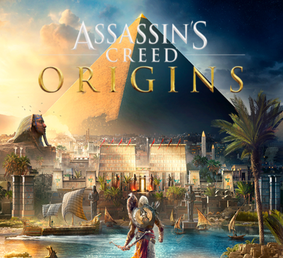
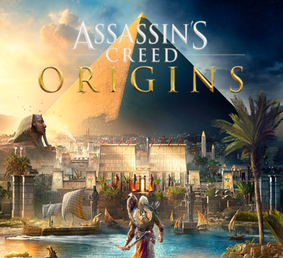
While at the end of the day Assassin’s Creed: Origins ties for my second favorite in the series, many of the design choices it implements, and especially some of its late game choices, left me scratching my head. And I’ll always want more puzzle-platforming.
Story
The story unfolds in typical AC fashion: broad stroke depiction of historical figures doing completely historically inaccurate things. And, as with other entries into the series, this one has pacing issues, convoluted plots and subplots, and an every growing hit list. If you enjoy the series, then expect to feel right at home in this game. If you don’t, then you expect to skip a lot of dialogue. But, let me caution against rushing through.
Bayek is a stand out character who deserves to be the protagonist in more than one title. His myopic motivation, albeit cliched, not only fulfills the Aristotelian definition of “Tragedy” but serves as a justifiable catalyst for action. Once he sets out on his path of revenge, and really these tales tend to revolve around revenge, we learn about Bayek’s ability for compassion, for justice, and for propriety. He is an enjoyable character and just as round as Ezio. The modern day story line, however, serves little to no point. Ubisoft should consider ditching it in favor of focusing entirely on the main protagonist.
Don’t get me wrong, there was a time when the modern day story had promise (and many will argue that it still does), but how much of that promise is fueled by “investment”? I was excited to traverse every inch of Rome, Venice, etc. in order to watch a few second clip to learn more about Juno, Minerva, Subject 16, etc. Desmond was an interesting enough character, and the sequences in Absergo, Italy, and specifically the Colosseum were enjoyable and really added something to the game (just like the puzzle platforming added to it as well—oh, the things we abandon). However, the series has devolved the modern day segments over several iterations into anything from a first person walking simulator to its most recent manifestation, a.k.a, “yet another attempt to get the audience to care about a story thread that has fallen dead—Oh hey, watch this story beat.” Perhaps acknowledging the meta narrative has been abandoned for the most part, that there are more games than there are narrative beats for the modern timeline, is okay—there are too many narrative threads, loose ends, weak connections, and too much lore for a satisfying payoff.
Missions
There is a lot of variety here, at least on the surface, yet game missions still boil down to two categories: fetch quests and kill quests. But, don’t let that deter you. Origins only exposes these broad, general classes when I skipped through quest dialog. In other words, Ubisoft has done a fantastic job breathing life into its characters—so much so that they now have the ability to make you care enough that you don’t notice the mission is going to end in yet another “infiltrate the outpost.” That’s not to say that I didn’t enjoy the infiltration. This is some of the absolute best stuff in this game.
As repetitive as they are, I rarely passed an opportunity to infiltrate an outpost/camp. In fact, often I had cleared the camp before I received a mission to go infiltrate it. They progress in difficulty as you move into the game, both in terms of tougher enemies and less places to hide. This gave me the chance to call on Senu, perhaps the best addition to this iteration of AC. I enjoyed slipping over into “eagle vision” to scout out enemies in a camp, plan my attack, and mark my marks. Having made my plan, I enjoyed slipping in and cleaning the camp out, no matter how large. This is where the game felt most like Assassin’s Creed to me, and where I found the most joy.
Combat
I’m sure there is a window to disagree here, but I felt that combat borrowed cues from Dark Souls. Everything from the lock-on mechanic to the button mapping and the constant flanking felt like it wanted to up the Souls-ian ante. For the most part this works. I was glad when Unity drifted from the paper-rock-scissors-“witch-time”-instant kill all of the enemies format. It forced me to plan out what I was going to do in a different way. Before, my greatest fear was being surrounded my more enemies than I could handle. Give me a few small groups and I would demolish them. Unity changed that. Even a small band of enemies became a challenge.
In some ways Origins goes back to the drawing board on combat and tries to build it from the ground up. However, that is not to say that combat is difficult. I quickly found myself slicing and dicing through enemies, locking on, dodging behind them, and then continuing to work the crowd. In so many ways, the combat is just as easy as it was prior to Unity. After a few upgrades, Bayek was easily taking down two enemies at a time (one in a charged attack and the other in a weapons throw special). The lock-on mechanic, however, is the area of combat Ubisoft must reconsider. It was a pain to use, rarely stayed locked on, and trying to switch targets during combat got me killed a few times. It simply does not work.
There are plenty of enemy types, but after a while they start to look like every enemy you’ve fought in every Assassin’s Creed game to date. Want a giant bruiser with a giant mace? Check. Want a powerful knight with fancy sword techniques? Check. Want a few guards with pikes? Got it. Archers? At least they are not sporadically strewn across village rooftops this time. There are more “boss” type enemies this time out, and I loved it. I want more special bosses with unique weapons and varied move-sets. It’s fun, engaging, and breaks up the monotony of killing the same foot solider over and over and over again.
There is a joke in my house. When I play one of these games we always talk about how I’m a “shitty assassin.” I often get seen, mess up a kill, or generally do something stupid in the middle of a mission. Origins, I guess, knew that about me because it created the formula for me to truly feel like a shadowy killer. The cover system is still in place, but at least this time they guards are more adamant about seeing you even when you are covered up.
Oddly enough, I found this iteration of AC to be the one were I didn’t feel the need to rely on, or even make use of, “trick” weapons. I shot maybe three darts through my entire play through. This is mixed. It’s positive in that I never felt like I was over relying on gimmicks to take down a few enemies before I ran in and mopped them all up. It’s bad in that they felt almost superfluous to me. The only thing I found myself using were the smoke bombs, and that was only because I’d accidentally hit the wrong button in combat and drop one.
MISC
There is no magic armor trapped in a cage this go round, and honestly that’s okay. I really feel that Ubisoft has taken the crafting formula it started in AC:III and brought it to maturity in Origins. The animal lair is a fantastic idea, and I found hunting to be enjoyable all around. Further, I found the idea of chasing down transports (whether or horseback or boat) a fantastic way to increase crafting supplies. I did find selling items a bit confusing the first few times I went to the blacksmith and choose “sell unneeded items.” It gets rid of all of your hunting loot—I only lost out on maybe two chances to upgrade my armor.
Further, Origins has random weapons drops, which really scratches and itch. Once I found the legendary sword I wanted (one stacked with skills/attributes), I upgraded it and stuck with it through most of the game. This mechanic works so well in the AC universe that I hope it becomes and staple of the series.
The addition of the colosseum breaths a lot of post game life into Origins. And that seems to be a reoccurring theme. Ubisoft wants Origins to be a persistent, living world with plenty of reasons to dive back in time and time again. Clearly, it has achieved this goal and it does with its action-rpg core. This is such a welcome change. The level system gates you into areas and missions for the most part. The upgrade system keeps you hunting and looting. And the combat is varied and light.
I like that the UI is minimal for the most part. I like the changes to the enemy alert system, and I like that most of the notifications simply blend in, allowing me to deal with them when I chose. Having said that, I did not like going into the menus. I had the same problem with Horizon: Zero Dawn. I don’t want to use the analog stick as a mock mouse, and I don’t want to have the cycle through the laundry list of weapons, etc., just to make sure that I am equipped properly. This, much like it did in H:ZD, led me to stick with pretty much the same equipment throughout the entire game. That habit was only intensified by the fact that I got to upgrade my weapons to my current level (a fantastic addition by-the-way).
Finally we have some puzzle-platforming again. I have not had this much fun since AC:2. Seriously, I love platforming and exploring puzzle-platforming dungeons, and I feel like Ubisoft heard my cry. After AC:2, Ubisoft slowly stripped the platforming away. Sure, you could still climb all over the town, but it’s just not the same. The series hit an all time low for me in Syndicate, the only one I’ve never finished, when they finally took all of the platforming away with the introduction of a grappling hook, hook-shot. If I remember correctly, I quit that very moment. Origins has brought platforming back in a real way. I loved finding tombs, exploring a few simple puzzles (it’s okay to move beyond weighted platforms, seriously), and for the first time in a while I got that itch scratched.
Late Game Choices
For everything I liked in this game, the last few missions almost destroyed it for me. I am, however, open to the idea that I simply misunderstood how the late game was supposed to function, or perhaps how the game itself was intended to be played. I did not cycle through gear. I did not cycle through weapons during combat. I found what worked for me and used it. Again, I’m open to the idea that I did not engage in the game the way the developers intended; however, if I played it correctly, then someone made some seriously flawed late game decisions.
I spent nearly the entire game playing as Bayek. There is an early mission that puts you behind the helm of a boat as Aya, Bayek’s lover and the mother of their child. If you played AC:III or Black Flag, then expect to feel at home in the boat. However, assume for a second that you have not, that this is your first encounter with AC’s brand of naval combat. Don’t fret, this early mission walks you through the process, shows you how to engage in combat, etc. I thought it was nice call-back to previous entries, and, when it was done, I thought nothing of it again. That is, until the end of the game. In the last few missions you have to assume control of the boat again and engage in several rounds of naval combat. There is no way to get out of this. There is no way to skip it. You simply must complete these missions before you are allowed to continue. This, I feel, would have been no problem if you had been given the opportunity to practice these game mechanics along and along. However, and I played most of the side quests, I don’t remember ever being given the opportunity to practice before I was thrown into these missions. Sure, they are not terribly difficult, but that is not the point. Throwing the player into a situation that he/she is not prepared for at such a late point in the game is simply bad game design.
What makes this even more frustrating is that up to this point in the game you’ve predominately used Bayek (apart from the afore mentioned naval training mission), so when the game made me switch to Aya for a few missions, I almost quite out of spite. Let me explain. I used the sword and shield throughout the game. I became comfortable with the sword. I knew its animations, its strengths and weaknesses, how to maneuver it, how to control a crowd with it. It has a certain speed I became familiar with. In all, it was my weapon of choice. Aya does not use the shield and sword. Her twin blades made combat faster because the weapons’ animations are much shorter. This literally threw off my fighting style in the last few missions, caused me a considerable amount of grief, and almost ruined the experience for me. Again, I am open to the idea that I played the game incorrectly; however, I have played every game in the series and don’t think I messed up. As such, throwing this curve ball is great from a narrative perspective, but it is an absolutely horrible game play decision.
In The End
Origins does almost everything well. Although I’m done with it, I will go back to it in the future—there is so much more to explore. Egypt is a big world, and I very much want to find more tombs, raid more outposts, and fill out my entire weapons roster (even if I don’t use them) with upgraded legendary weapons. If we don’t get another Assassin’s Creed game next year that’s fine with me. Origins is that good.
 A. D. Bowen