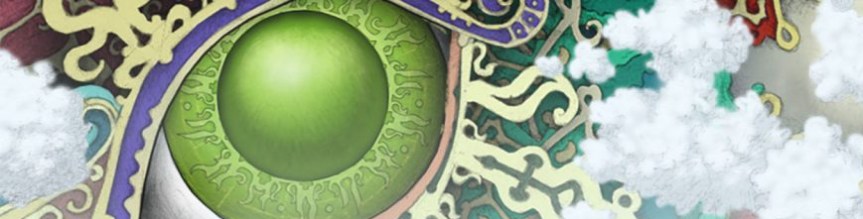
Any review lacking in a place to start should consider a good old fashion caveat: I’ve never developed a game. So, it is with pure speculation that I suggest that analyzing how the eyes move across the screen must be daunting task. For all I know it’s the easiest thing in game development—I have a sneaking suspicion, however, that its not so easy. My guess is that studying how the eyes track how a game unfolds is a task meant for a team of developers. To attempt such a feat by one’s self, then, must necessitate tapping into the space occupied by architects, artists, photographers, dancers, actors, and others who chiefly consider how the eyes track movement, how a line is created. Is it any wonder, then, that Gorogoa’s art, even its narrative, revolves around eyes and patterns?
What Joel Corelitz accomplishes, he does so rooted in testing the way we visually dissect his work. He forces us to watch as the work opens itself by degrees, allowing us to avert our gaze where he wills. In many ways, we are merely turning the pages of this game, engaging it as one does a broken machine—studying its movements to try a figure out where it went wrong.
The game consists of four white panels. Onto those panels the game places anywhere from one to four interactive tiles, which contain visual puzzles of varying degrees if difficulty. Sometimes the you need to line up two tiles to move a character from one panel to the next. Often you have to zoom in and out to match adjacent tiles to allow animations to play, thus unlocking new levels, scenes, and red herrings. These basic gameplay mechanics comprised the bulk of Gorogoa. Yet, the game is more than just the sum of its parts.
On top of its simple moment set, Corelitz weaves a silent narrative—one rooted in the seasons of life, war, and longing. Don’t expect the game to outright tell you what’s going on. Instead, the story unfolds with a series of impressions, which jump in time and space. One minute you are a child wandering through what can best be described as a secret garden, another you transform the sun into a boulder and push it up a hill in true Sisyphean fashion—the latter of which emerges as a metaphor for life and depression, where we are forced to confront the reality that our days, the watching of the sun rise and set, are mirrored in Sisyphus’s plight. It can be as heady as you like or as simple as a child’s stacking game. It depends on how much you want to put into it. The game allows you to parse out the meaning you see fit as it is content concerning itself with following your eyes wherever they go.
Simply put, the game is beautiful, and it has at its core a sense of implied storytelling that connects it to some of the best minimalist, abstract work. There is no tutorial, but there is no need for one. You come to know the game the way one does a character in a story—by degrees and digressions.
 A. D. Bowen